
Why Fibromyalgia Needs a Psychologist: What the RESTORE Program Offers That Medication Alone Can't

By Dr. Meagan Daley, Ph.D., C.Psych | Registered Psychologist | Ontario & Quebec
RESTORE
Reclaim · Empower · Soothe · Thrive · Open · Rebuild · Evolve
Reclaim your life from pain
Empower yourself with knowledge and skills
Soothe your nervous system
Thrive through structured pacing and rest
Open to reconnection with self and others
Rebuild your identity and sense of possibility
Evolve beyond survival into living
There is a particular kind of exhaustion that comes with fibromyalgia. Not just the physical fatigue, though that is very real, and not just the pain. It is the exhaustion of not being believed. Of spending years cycling through appointments, tests, and treatments that offer partial relief at best. Of trying to explain to the people you love why you cancelled again, why you needed to rest again, why you pushed through on a good day and then spent three days recovering from it.
If you have lived this, you already know something that the research is finally catching up to: fibromyalgia is not "just" a pain condition. It is a whole-system experience, and treating only one part of it is unlikely to get you very far.
This is where psychology comes in. But before we get there, it helps to understand the "who" and the "what" of fibromyalgia itself, because knowing what you are actually dealing with changes everything about how you approach it.
WHAT IS FIBROMYALGIA, AND WHERE DOES IT COME FROM?
Fibromyalgia is a chronic, complex pain condition characterized by widespread musculoskeletal pain, profound fatigue, sleep disturbance, cognitive difficulties often referred to as fibro fog, and heightened sensitivity to touch, light, sound, and temperature. It affects an estimated 2 to 4 percent of the population, with women diagnosed significantly more often than men, though growing evidence suggests it is underdiagnosed in men rather than genuinely less prevalent.
Despite decades of research, fibromyalgia has no single identifiable cause. What the evidence points to instead is a convergence of factors: genetic predisposition, early life stress or trauma, physical injury, infection, or prolonged psychological stress can all play a role in triggering or amplifying the condition. What these pathways share is their eventual effect on the central nervous system, which becomes dysregulated in its processing of pain signals, amplifying sensations that would not register as painful in a nervous system that was not sensitized.
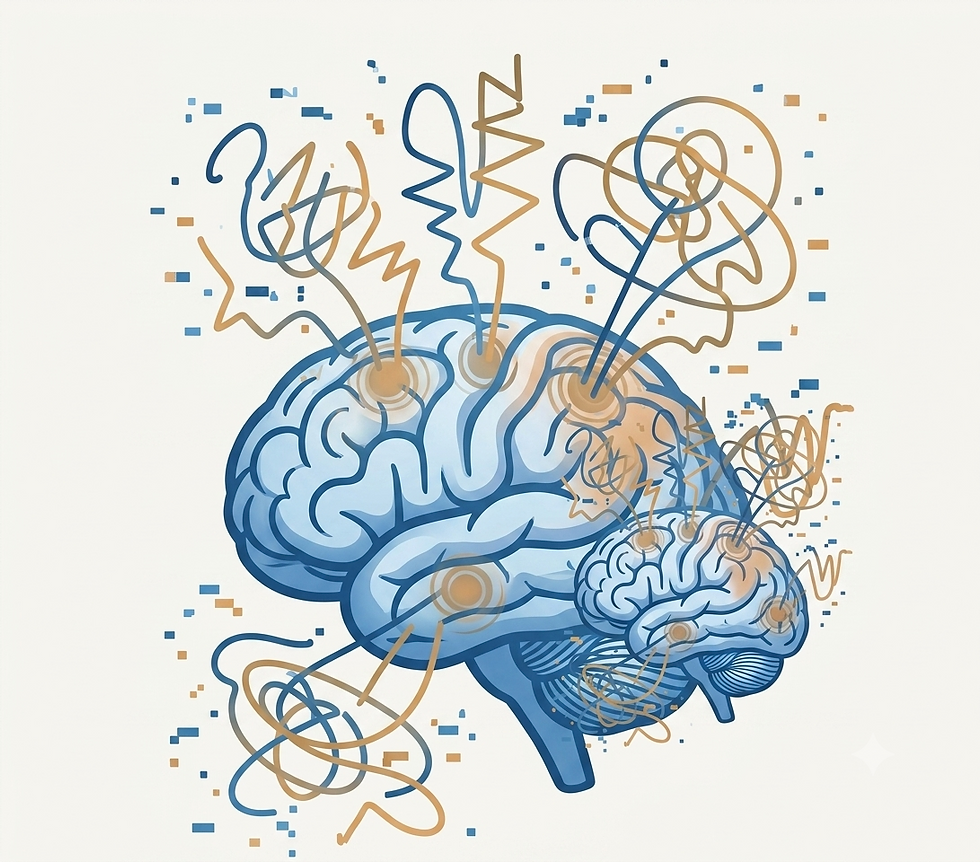
This is why fibromyalgia does not show up on standard imaging or blood tests. The problem is not in the tissues. It is in the system that interprets them. Understanding this is not just academically interesting. It is clinically liberating, because it shifts the question from "why can't anyone find what is wrong with me" to "how do we work with a nervous system that has learned to be on constant high alert." That is precisely the question RESTORE was designed to answer.
WHAT THE SCIENCE ACTUALLY SAYS
Fibromyalgia is now understood to involve central sensitization, a state in which the central nervous system becomes amplified in its processing of pain signals. The pain is physiologically real. It is also profoundly shaped by the nervous system's learned patterns of alarm, by sleep disruption, by autonomic dysregulation, and by the cumulative psychological toll of living with an invisible illness.
A 2017 Cochrane review of psychological therapies for chronic widespread pain found that cognitive behavioural approaches produced meaningful reductions in pain, disability, and negative mood, with the strongest effects seen when interventions were structured, multimodal, and sustained over time rather than delivered in a single format or session (Williams et al., 2017). A meta-analysis published in Pain confirmed that psychological interventions targeting sleep, pacing, catastrophizing, and nervous system regulation produced durable gains not achieved by pharmacological treatment alone (Hauser et al., 2010).

Medication has a role. Duloxetine, pregabalin, and low-dose naltrexone, among others, can meaningfully reduce symptom burden for some people. But the evidence consistently shows that the biggest and most lasting improvements in quality of life come from structured, skills-based psychological programs, particularly those that address the full ecosystem of fibromyalgia: sleep, pacing, nervous system regulation, emotional processing, and meaning-making in the face of a life that has been genuinely disrupted.
THE BOOM-AND-BUST TRAP
One of the most clinically significant patterns in fibromyalgia is what is often called the boom-and-bust cycle. On a better day, the temptation to finally do all the things you have been putting off is almost irresistible. The laundry. The errands. The visit with a friend you have been cancelling for months. And then, predictably, comes the crash.
This is not a failure of willpower. It is a failure of pacing, which is understandable when no one has ever taught you to pace for a condition like this. Pacing in chronic pain is a genuine skill, and it is one that psychological intervention is uniquely positioned to teach. Not because psychologists can manage your schedule, but because learning to pace requires changing deeply ingrained patterns of thinking and behaviour around activity, rest, guilt, and identity.
"I used to be someone who did things," one client recently shared with me in a private session. "Now I negotiate with myself every morning about what one thing I am allowed to do today." That negotiation, and the grief underneath it, is exactly the kind of material that a well-designed psychological intervention can address.
SLEEP AND PAIN: THE BIDIRECTIONAL PROBLEM
The relationship between sleep and pain in fibromyalgia deserves particular attention. Disrupted sleep increases pain sensitivity. Increased pain disrupts sleep. Most people with fibromyalgia are caught in both directions of this cycle simultaneously, and it is, frankly, brutal.

As a psychologist with a research background in sleep disorders and training in Cognitive Behavioural Therapy for Insomnia (CBT-I), I know this territory well. CBT-I is the first-line recommended treatment for chronic insomnia by virtually every major sleep medicine body in the world, and its principles transfer meaningfully into chronic pain populations. Addressing sleep is not a secondary concern in fibromyalgia treatment. It is central.
After years of hearing stories of this deep suffering, and in order to address the multifaceted nature of chronic pain and fibromyalgia, I developed the RESTORE program. RESTORE integrates structured sleep support throughout its nine weeks precisely because you cannot meaningfully address the pain cycle while the foundation of rest remains unstable.
WHY "JUST MANAGE YOUR STRESS" IS NOT AN ANSWER
Many people living with fibromyalgia arrive in my practice having been told, at some point, to manage their stress better. This advice, while well-intentioned, tends to land as dismissive. And it misses the mark clinically.

Stress management as a slogan is not treatment. What the evidence supports is structured nervous system regulation: learning to recognize and shift the physiological state that underlies hypervigilance and pain amplification, using practices grounded in somatic mindfulness, Acceptance and Commitment Therapy (ACT), and Mindfulness-Based Stress Reduction (MBSR). These are not relaxation techniques. They are skills for changing the relationship your nervous system has with pain signals, so that the alarm volume can be gradually turned down.
This is not about thinking your way out of pain. It is about retraining the system that processes pain, which is a very different project, and one that takes time, structure, and support.
THE ISOLATION PROBLEM
There is something else that the clinical literature documents but that clinical encounters often underaddress: the profound social isolation of fibromyalgia.
When pain is invisible, relationships become complicated. People stop extending invitations because you have had to cancel so often. You stop accepting them because the unpredictability of your symptoms makes planning feel futile. Over time, the social world shrinks, and with it, an important buffer against pain amplification. Social connection is not incidental to health; it is physiologically protective. Loneliness, by contrast, has measurable effects on pain perception, immune function, and nervous system regulation.
A group-format program like RESTORE does something that individual therapy alone cannot fully replicate: it puts you in a room, virtually, with other people who understand. The therapeutic value of that recognition, the relief of not having to explain yourself, is real and it is evidence-based. Peer support in structured chronic pain programs consistently shows benefits for mood, perceived isolation, and treatment adherence (Lorig et al., 2001).

THE WEIGHT OF NOT BEING BELIEVED: STIGMA, SHAME, AND A PAINFUL HISTORY
There is something that rarely gets named directly in clinical writing about fibromyalgia, but that I hear again and again in my practice: the shame.
Not just the frustration of being dismissed, though that is real enough. The shame of having internalized, even partially, the message that your pain is exaggerated. That you are somehow too sensitive, too emotional, too much. That if you were simply stronger, or less anxious, or less hysterical, you would be fine.
That word, hysterical, has a long and troubling history in medicine, and fibromyalgia has not escaped it. For much of the 20th century, widespread pain without visible pathology was understood through a lens of female psychology: anxious women, somatizing women, women whose pain was "all in their heads." A 2025 metasynthesis published in the Journal of Advanced Nursing confirmed what patients have long known, that stigma in fibromyalgia arises specifically from the invisibility of symptoms, the difficulty of obtaining a diagnosis, and a history of gendered stereotyping in which women's pain was minimized or attributed to presumed emotional excess (Colombo et al., 2025). The consequences, the research found, include diminished dignity, eroded trust in healthcare providers, and compounded physical and psychological suffering.
This is not ancient history. Many people arriving at my practice in 2026 carry this legacy in their bodies, having spent years doubting themselves, editing their descriptions of pain to sound more credible, or simply going quiet because it was easier than being dismissed again.
I want to say this clearly: the shame does not belong to you. It belongs to a medical system that, for too long, lacked both the science and the humility to sit with what it could not yet explain.
The neuroscience of central sensitization has changed that understanding substantially. Your nervous system learned to amplify pain signals. That is a physiological process, not a personality flaw, not a manifestation of anxiety, and not something you brought on yourself. It is also, with the right structured support, something that can be gradually and meaningfully shifted.
"The worst kind of hurt is the kind no one believes."
House M.D.
It is a fictional line form the TV show "House," but it captures something true about the lived experience of fibromyalgia that a great deal of clinical writing does not.
WHEN PAIN CHANGES WHO YOU THINK YOU ARE
And as if that isn't enough, there's a particular kind of loss that comes with chronicity that doesn't always get named: the slow erosion of your sense of self.
It rarely happens all at once. It begins with the things you can no longer do reliably, the commitments you have to renegotiate, the roles that quietly shift. You were the person who showed up. Who organized things. Who pushed through. And then, gradually, you were not. Not because you chose differently, but because your body made the choice for you, over and over, until you stopped trusting it entirely.

What follows is often a painful renegotiation of identity. Who am I if I cannot do the things that defined me? What is my value to the people in my life if I need more than I can give? These are not irrational questions. They are the honest questions of someone whose life has been genuinely altered by an illness that most people around them cannot see or fully understand.
And then there is the fear that most people carry quietly and rarely say out loud: that the people in their lives are beginning to see them differently. That partners are growing weary. That friends have quietly stopped expecting them to show up. That colleagues have mentally reassigned their capabilities. The painful truth is that sometimes this fear is not entirely unfounded. Chronic illness does change relationships, and pretending otherwise is not compassion. What matters clinically is how we work with that reality, rather than around it.
Research on chronic pain and identity confirms what patients already know. Self-concept, the internal story we carry about who we are and what we are capable of, becomes destabilized when illness is prolonged, unpredictable, and socially invisible (Snelgrove & Liossi, 2009). The grief that accompanies this destabilization is real, and it compounds the physical burden in ways that standard pain management rarely addresses.
RESTORE includes explicit work on identity and self-concept alongside its other pillars, because functional recovery without attending to who you are becoming in the process is incomplete. You deserve to rebuild not just your capacity for daily living, but your sense of yourself as someone worthy of care, of presence, and of a life that is more than the sum of your symptoms.

WHAT RESTORE ACTUALLY IS
RESTORE is a structured, evidence-based, nine-week psychological program developed for adults living with fibromyalgia and chronic pain. It is delivered entirely virtually, in recognition of the energy constraints that make in-person attendance difficult on many days.
The program works across five integrated areas: nervous system regulation, activity pacing, sleep support, emotional processing, and social reconnection. Each week builds on the last. Participants receive weekly digital workbooks, guided somatic mindfulness recordings, and structured pacing tools. Sessions are delivered in small, supportive group cohorts, with individual consultation available for those who prefer a private format.

The program draws on the best of what the clinical evidence supports: Cognitive Behavioural Therapy (CBT), Cognitive Behavioural Therapy for Insomnia (CBT-I), Acceptance and Commitment Therapy (ACT), Mindfulness-Based Stress Reduction (MBSR), pain neuroscience education, graded activity, and self-compassion practices. These are not loosely assembled techniques. They are deliberately integrated and sequenced so that each modality reinforces the others, addressing the full complexity of fibromyalgia rather than any single dimension of it.
RESTORE is not a passive program. It requires engagement, practice between sessions, and willingness to look honestly at patterns that have become entrenched over years of living with pain. But for people who are ready to invest in something structured and evidence-informed, the potential for meaningful functional recovery is real.
A NOTE ON WHO THIS IS FOR
RESTORE is not for people who are in acute crisis or who require intensive medical stabilization. It is for adults who have a diagnosis or strong clinical picture consistent with fibromyalgia or chronic widespread pain, who are medically stable, and who are ready to engage with a psychological approach to recovery.
It is also, importantly, for people who have tried other things and found them insufficient. If you have been to physiotherapy, tried several medications, read the books, and still feel like you are managing rather than living, RESTORE was built with you in mind.
READY TO LEARN MORE?
RESTORE is currently accepting priority applications for our Ontario-wide Fall 2026 virtual cohort. If you are curious about whether the program might be right for you, I would welcome the conversation.
Learn more about the RESTORE program and apply for the Fall 2026 cohort: www.my-psych-care.com/restore-ontario
Or call directly: 613-434-4247.
RESOURCES WORTH KNOWING
Book
"The FibroManual: A Complete Fibromyalgia Treatment Guide for You and Your Doctor" by Ginevra Liptan, MD
Dr. Liptan is both a physician and a fibromyalgia patient herself. This book is one of the clearest, most clinically grounded patient-facing guides available, covering the underlying mechanisms of fibromyalgia alongside practical, integrative treatment strategies. It is the book I most often suggest when a client wants to understand what is actually happening in their body.
Website
The National Fibromyalgia Association (www.fmaware.org)
A reliable, patient-centred resource for information on fibromyalgia research, treatment options, and advocacy. Well-organized and accessible, with resources for both patients and healthcare providers.
Research
Colombo, V., et al. (2025). The experience of stigma in people affected by fibromyalgia: A metasynthesis. Journal of Advanced Nursing. https://onlinelibrary.wiley.com/doi/10.1111/jan.16773
For those who want to read the research on stigma and fibromyalgia directly, this 2025 systematic review is the most comprehensive current synthesis available. It is rigorous, compassionate, and long overdue.
Community
MyFibroTeam (www.myfibroteam.com)
A peer support network specifically for people living with fibromyalgia. A valuable space for connection, shared experience, and the particular relief of not having to explain yourself from scratch.
REFERENCES
Colombo, V., et al. (2025). The experience of stigma in people affected by fibromyalgia: A metasynthesis. Journal of Advanced Nursing. doi:10.1111/jan.16773
Hauser, W., Bernardy, K., Arnold, B., Offenbacher, M., & Schiltenwolf, M. (2010). Efficacy of multicomponent treatment in fibromyalgia syndrome: A meta-analysis of randomized controlled clinical trials. Arthritis Care & Research, 61(2), 216-224.
Lorig, K. R., Ritter, P., Stewart, A. L., Sobel, D. S., Brown, B. W., Bandura, A., & Holman, H. R. (2001). Chronic disease self-management program: 2-year health status and health care utilization outcomes. Medical Care, 39(11), 1217-1223.
Snelgrove, S., & Liossi, C. (2009). An interpretative phenomenological analysis of living with chronic low back pain. British Journal of Health Psychology, 14(4), 735-749.
Williams, A. C. de C., Fisher, E., Hearn, L., & Eccleston, C. (2017). Psychological therapies for the management of chronic pain (excluding headache) in adults. Cochrane Database of Systematic Reviews, Issue 11. Art. No.: CD007407.
Dr. Meagan Daley, Ph.D., C.Psych is a Registered Psychologist registered in Ontario (CPBAO #7560) and Quebec (OPQ), practicing entirely online. She specializes in CBT-I, fibromyalgia and chronic pain, anxiety, burnout, and couples therapy. Sessions are available in English and French.


Comments