
Understanding Rumination: A Path to Healing

Updated: Apr 10
There is a particular kind of mental activity that most of us know intimately, even if we've never had a name for it. It goes something like this: something happens - a tense conversation, a mistake at work, or a vague sense that someone is upset with you. Instead of processing it and moving on, your mind takes it home, makes a cup of tea, and settles in for the evening.
You replay the conversation. You imagine what you should have said. You wonder what they meant by that pause. You consider the worst-case scenario, then a worse one. You tell yourself to stop thinking about it. And then you think about it some more.
This is rumination. If it sounds familiar, you are very much not alone.
What Is Rumination, Exactly?
Rumination is the tendency to repetitively and passively focus on negative feelings or problems. We turn them over and over in our minds without moving toward resolution. The term comes from the Latin word for what cows do with their food (yes, really, we are essentially rechewing our emotional cud). Psychologists have been studying it seriously since the late 1980s when researcher Susan Nolen-Hoeksema first identified it as a distinct and clinically significant pattern.
What makes rumination different from useful reflection is that it doesn't lead anywhere. Healthy problem-solving is active: you think about a problem with the goal of finding a solution or making a decision. Rumination is passive: you think about the problem, its causes, its implications, and what it means about you - in circles, indefinitely, without resolution.
In the most technical of terms, it's your brain spinning its wheels in the mud.
Why Do We Do It?
Here is the somewhat uncomfortable truth: rumination feels productive. It feels like we are being thorough, careful, and responsible. Surely if we just think about this a little more, we'll figure it out. We'll be prepared. We'll prevent the bad thing from happening.
This illusion of usefulness is part of what makes rumination so sticky. Research by Edward Watkins at the University of Exeter has found that ruminators often hold the metacognitive belief that rumination is helpful. They see it as a form of problem-solving or self-protection, even as the evidence in their own lives suggests otherwise.
The reality is that rumination is more closely associated with getting stuck than with getting anywhere. It is worry's quieter, more persistent cousin: less acute than a panic attack but potentially more corrosive over time precisely because it can feel so reasonable.
The Rumination-Anxiety Connection
Rumination is one of the most robust predictors of anxiety disorders across the research literature. When the mind rehearses threats - be they real, imagined, or somewhere in between - it keeps the nervous system in a low-grade state of alert. Cortisol and adrenaline, the hormones associated with the stress response, don't require an actual emergency to show up. The vividly imagined one will do just fine.
This creates a feedback loop that can be genuinely exhausting: anxiety produces rumination, rumination sustains anxiety, and the whole cycle becomes self-reinforcing. Clients often describe it as feeling like a browser with thirty tabs open and no clear way to close any of them.
If this resonates, you might find it useful to read more about how anxiety develops and what evidence-based treatment looks like.
The Rumination-Insomnia Connection
Ask anyone who ruminates whether it tends to get worse at night, and watch their expression.

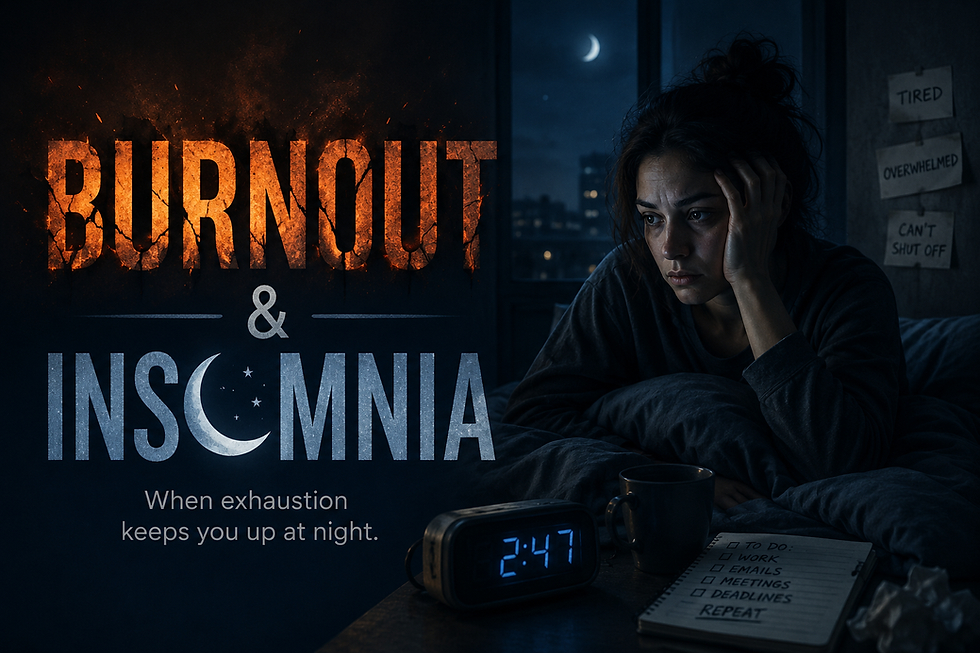
Insomnia and rumination have a particularly well-documented and mutually miserable relationship. The darkness and quiet of bedtime remove most of the external stimulation that keeps ruminative thinking at bay during the day. There is no meeting to get to, no task to complete, no conversation to half-listen to. There is just you, the ceiling, and the thought you've been avoiding since Tuesday.
Research by Allison Harvey at the University of California Berkeley has identified "sleep-related worry and rumination" as a central maintaining factor in chronic insomnia. In other words, it's not just that insomnia keeps you awake; in fact, the thinking patterns that accompany it are actively preventing sleep from happening.
The good news is that this is precisely what Cognitive Behavioural Therapy for Insomnia (CBT-I) addresses: not just sleep hygiene, but the thought patterns that are keeping your nervous system switched on when it should be winding down.
The Rumination-Burnout Connection
Rumination doesn't only live in the bedroom. In professional and high-demand contexts, it often shows up as the inability to mentally leave work at work. This might look like replaying interactions with colleagues, rehearsing difficult conversations that haven't happened yet, or second-guessing decisions long after they've been made.
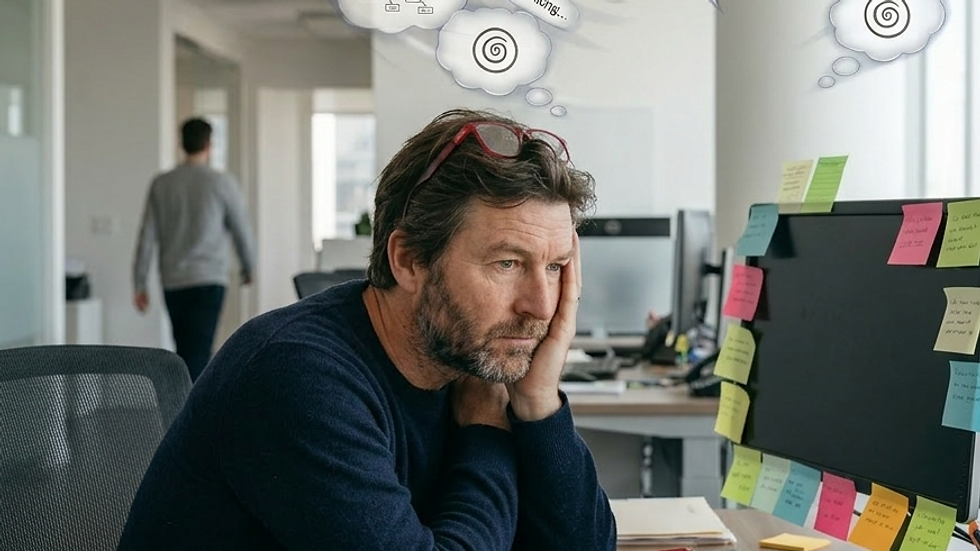
Studies on workplace stress consistently find that the failure to psychologically detach from work during off-hours - driven largely by rumination- is one of the strongest predictors of burnout. You can technically be sitting on your couch on a Saturday afternoon and still be, in every meaningful sense, at work.
If this sounds like your particular flavour of overthinking, it may be worth reading about burnout and what recovery actually involves.
So What Actually Helps?
This is the part where I resist the urge to hand you a listicle and send you on your way. While there are genuinely effective tools for managing rumination, they tend to work best when they're understood rather than just applied.
That said, here is what the evidence actually supports:
1. Scheduled Worry Time
This one sounds almost comically simple, and yet it has robust research support. The idea is to designate a specific 20-minute window each day (not at bedtime!) as your official rumination slot. When ruminative thoughts arise outside that window, acknowledge them and mentally postpone them: "I'll think about that at 5 PM."
What this does is interrupt the automatic quality of rumination. Instead of thoughts arriving uninvited and staying indefinitely, you are gently and repeatedly reasserting some agency over when and how you engage with them.
2. Cognitive Defusion (From ACT)
Acceptance and Commitment Therapy offers a technique called defusion, which is essentially about changing your relationship to thoughts rather than fighting their content. Instead of saying, "I am a failure," the practice involves noticing, "I am having the thought that I am a failure." It sounds like a small linguistic shift, but it creates just enough psychological distance to reduce the thought's grip.
The goal isn't to think positively. It's to think less literally - to recognize that a thought is a mental event, not a fact about reality.
3. Mindfulness Practice
Mindfulness practice - specifically the kind rooted in Mindfulness-Based Stress Reduction (MBSR) - has been shown in numerous studies to reduce ruminative thinking over time. The mechanism seems to be attention training: the repeated practice of noticing where your mind has gone and returning it, without judgment, to the present moment.
This doesn't mean emptying your mind (a popular misconception that has discouraged many people from trying). It means noticing the thought, recognizing it as a thought, and gently redirecting attention. Repeatedly. Probably many more times than feels reasonable. That is, in fact, the practice.

If you'd like to get a feel for what mindfulness actually involves, I have a collection of free guided meditations available on this site.
4. Behavioural Activation
One of the most counterintuitive findings in the rumination literature is that doing something - almost anything that requires absorbed attention - is often more effective at interrupting the cycle than trying to think your way out of it. Exercise, creative work, cooking, or a conversation that requires your full presence are not avoidance. They are genuine interventions.
The mind ruminates most when it has nothing else to do with itself.
5. Therapy
When rumination is entrenched - when it has been the wallpaper of your inner life for years, or when it is contributing to clinical levels of anxiety, depression, or insomnia—self-help strategies have a ceiling. Therapy, particularly CBT and ACT-based approaches, can address the deeper patterns that keep rumination in place: the underlying beliefs, the threat sensitivity, and the relationship between thoughts and identity.
If you've recognized yourself in this post and you're wondering whether talking to someone might help, I'd invite you to book a free 15-minute discovery call. It's a low-stakes way to find out whether therapy might be a useful next step.
A Final Thought
The philosopher and psychologist William James once wrote that "the greatest weapon against stress is our ability to choose one thought over another." That's a lovely sentiment, and I don't entirely disagree with it. However, I'd add a small footnote: that ability is a skill, not a given. It can be learned, practiced, and strengthened.
You are not failing at being a person because your mind won't quiet down. You are experiencing something very human. The question is simply whether you want to keep living inside the loop or whether you'd like to start building a door.
If perchance you think that burnout is part of what's driving your rumination, you might also find this useful: Understanding Burnout, and What Recovery Looks Like.
Dr. Meagan Daley is a PhD psychologist registered with the College of Psychologists and Behaviour Analysts of Ontario (Permit #7560) and the Ordre des psychologues du Québec. She offers virtual therapy for adults across Ontario in English and French, specializing in anxiety, insomnia (CBT-I), burnout, stress, and couples therapy.
If you are suffering from burnout, anxiety, insomnia, or other psychological issues and would like help, you can directly book your first session here, or Book a free discovery call on our Contact Page.


Comments